
Mesylab
How to think about the future of companies ?
January 25, 2018, was the day Carrefour group announced a 1233-job loss in Belgium. This was especially shocking for the workers, as they had already experienced major cuts and job losses in 2010 when the company cut more than 1700 jobs and closed 14 hypermarkets in Belgium.
Following this announcement, I published a column in a Belgian newspaper, provocatively named “Carrefour didn’t take the time to think about its future. Who’s next?”. I explained that workers had to pay the consequences of no or limited strategic thinking over the long-term future of the company and over the major trends in retailing.
In both instances (in 2010 and in 2018), the group management justified his decision by a change in consumption habits, driven by e-commerce, local commerce and support to organic, fresh and/or local food.
These are clearly not new trends. These societal evolutions have been observable for more than 10 years. The rationale of the Carrefour group is therefore, at best, based on limited attention to these trends along the past 10 years.
This lack of future thinking is not a surprise per se. It is related to the functioning of many companies that do not take the time to think about long-term strategies.
Rather than a reactive plan to these trends that the company was not ready to face, such a multinational firm, and basically any firm in an ultra-competitive sector, needs thorough and inclusive foresight thinking that allows to consider the long-term in a complex environment.
 Three requirements must be met for such corporate foresight to emerge.
First, companies must adopt a new approach oriented towards the long-term future, beyond annual budgetary cycles linked to dividend payment. For such an approach to exist, companies must invest in skilled human resources able to develop, support and diffuse such endeavour.
Second, companies must consider their future in a systemic manner, taking into account the multiple dimensions embedded in a particular context. These dimensions can be structural or conjectural, central or peripheral, global or local, economic or social. For example, in terms of mass retail, it is necessary to consider changes in consumption trends both at a local, city-centred level and in an international trade global context.
Third, corporate foresight must be inclusive. It means it is essential for a firm to mobilise collective intelligence to co-create future strategies. In retail, workers often are the first consumers. Their opinions count, especially since they can bring up diversified perspectives and enrich the management ones.
In an economic world in permanent mutation(s), companies must not be reactive to changes. They must adopt a pro-active forward-looking attitude considering a longer time horizon and embedding perspectives of all stakeholders. Such an approach could have helped avoid recent social dramas.
Tools exist to conduct systemic and participatory corporate foresight activities at a larger scale and to co-create new solutions for a future that is much more supported by the concerned actors. Such tools are developed in universities, administrations and associations. Therefore, it is essential to reconsider dimensions included in these strategic future-thinking activities.
Among these solutions, we believe Mesydel is an effective tool to conduct such activities. Mesydel is an online consultation tool that implements the principles of the Delphi method and facilitates the organisation and analysis of such survey.
Why Mesydel is an adequate tool in this precise case?
Several methodological and practical difficulties emerge when implementing traditional consultation methods. Three of them are listed below:
-
Compartmentalisation: some methods, such as classical surveys and polls, can lead to a compartmentalisation of the actors’ opinions and positions while building a common vision. Participants interact in a limited and non-systematic manner.
-
Practical constraints: these are often central aspects of participatory processes. In some companies (as in any other context), gathering participants at the same time and place is a complex if not impossible undertaking, considering everyone’s agenda and location.
-
Constraint on freedom of speech: in a “physical” (by opposition to online) participatory process, such as a workshop, power unbalances emerge and reduce the freedom of speech of some participants. For example, if an employee participates in the same workshop as his/her boss, he could feel a power constraint that would restrain him from freely expressing him/herself.
Mesydel goes beyond these three main constraints that are inherent to participatory process.
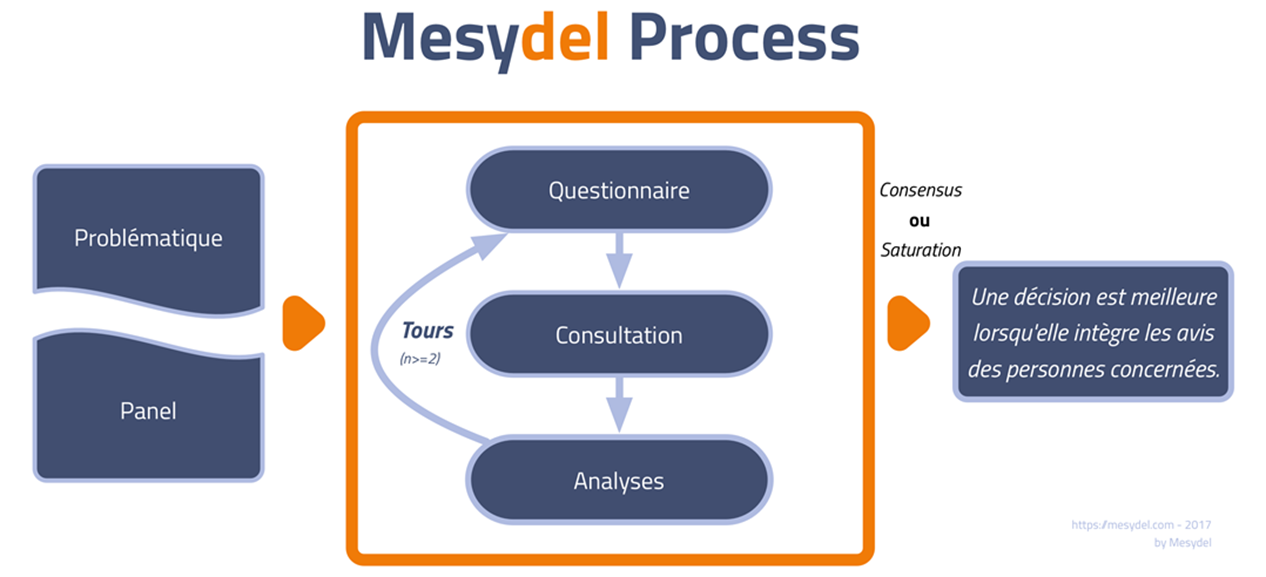
First, Mesydel allows to decompartmentalise debates through several successive rounds of questionnaire. The scheme below is explicit about how a Delphi survey usually works:
Each questionnaire aims at collecting qualitative and quantitative information and data that are analysed by the moderators of the survey. They determine whether a consensus is reached for each question. If this is not the case, a new questionnaire is organised in which participants are presented with the results of the previous round and are asked to position themselves in the light of these results. This iterative process allows participants to become aware of the group positioning and to create a sense of community in order to build a consensus on particular aspects.
In certain instances, no consensus is found after several rounds of questionnaire. The survey then allows to identify and explore dissensus points to make a decision regarding them. This process is inspired by the Delphi method implemented within Mesydel.
Second, Mesydel is an online tool that facilitates the interaction between participants with conflicting agendas or that are geographically dispersed. A questionnaire is generally open for 2 to 3 weeks, offering anyone the opportunity to answer at the most adequate time. For example, Mesydel is regularly used to consult policy actors on a territory. These include librarians, experts in alphabetisation and agents in charge of emergency planning for highly-sensitive industrial sites.
Finally, Mesydel organises consultation in which anonymity is a central aspect. In this context, the arguments of a participant always prevail upon a hierarchical or social position. Each participant is therefore able to freely express his opinions.
An example of a participatory and interactive process
Using Mesydel to build a shared vision of the future of a company can elaborate upon such process*. It is indeed possible to design a three-round survey that allows the emergence and stabilisation of a shared corporate vision. Each round is a particular step to reach this shared vision.
These three steps are the exploration, the construction and the validation.
The exploration phase aims at establishing a diagnosis of the initial situation through the identification of the main dimensions of the future of the company while evaluating their current state. It also helps emphasise wishes and needs among participants regarding their ideal company considering the defined time horizon.
The construction phase goes beyond the diagnosis and allows a first strong interaction between participants by presenting them the main results and positions from the first round. They can therefore position themselves based on their newly-acquired knowledge of other participants’ positions regarding the future of the firm. This phase facilitates agreements on core principles and values that would be the framework of their vision and helps identify constructive solutions to implement them.
The validation phase confirms some hypotheses, furthers consensus on principles and concrete solutions and highlights inextricable points of dissensus.
Of course, reality is much more complex and this generic process must be tailored to the company’s needs. Moreover, these three phases can sometimes overlap in the same round of questions, due to a particular situation.
If you want to know more about Mesydel, visit our website!
*This post does not consider several methodological questions regarding to choices in terms of participants and panel, of the timing of the survey, of the time horizon towards which a company wants to project itself or the pre-survey process. These questions must not be overlooked and must be systematically tackled by the people in charge of the survey.