
Mesylab
What is the Delphi method and what is it used for?
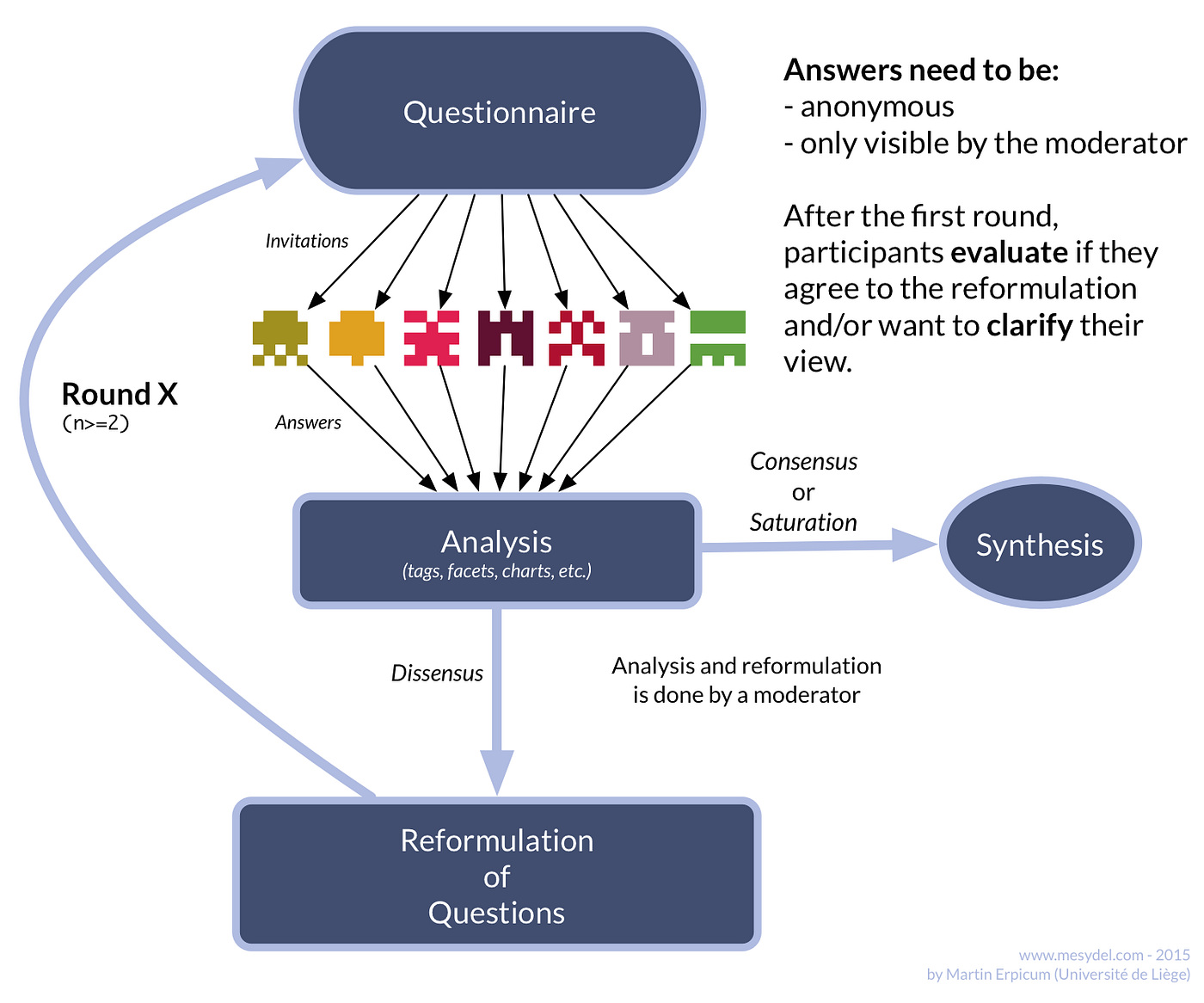
The Delphi method is a structured communication technique originally developed as a method of systematic and interactive forecasting based on a panel of experts.
“The Delphi method is a qualitative and quantitative prospective tool, consisting of an aggregation of (experts) opinions. It is a systematic method of formal questionnaire interrogation using intuitive judgement and knowledge of a panel which is geographically dispersed, used to make predictions by expressing rational opinions on questions where there is no absolute answer “- Ieroncig, 1983
There are many applications for this method, depending on the field — medicine, psychology, education sciences, management, economics, social sciences, etc. — or on the objective of the consultation: technological innovations, anticipation of a market or trend, strategic prospecting, participative management, participative design, etc.
The main characteristics of the methodology
The Delphi method usually takes the form of a written questionnaire. This allows for anonymous and independent consultation and debate, thus avoiding pitfalls of direct confrontations, both social (e.g. power relations in a group) and practical (time-consuming activity, especially when it comes to geographically dispersed participants). The responses are only visible to the moderator and not to the participants, to avoid self-moderation bias.
In summary, the method allows an iterative consultation of experts and/or stakeholders, in the written form, with the aim of obtaining an increasingly consensual response (the ultimate goal being to get closer to a consensus among experts). The experts, ranging from a dozen up to hundreds of people, are invited, as the rounds go on (2, 3 or more) to position themselves in relation to a question according to the answers of the other participants. All answers are based on the principle of anonymity and independence of judgement. The presentation of the questions can vary: it can be open and/or closed questions (qualitative and/or quantitative).
Consensus / dissension
The method has been constructed to encourage consensus on specific themes such as priority setting, technological foresight, or decisions about certain technical or medical issues. More precisely, the Delphi method creates conditions that are favourable to a convergence of opinions, while at the same time making it possible to clearly discern the points of dissension. The study of the latter is important, as it legitimizes the method and often leads to redefining the initial problem, again leading to consensus. Also, the key feature of the Delphi method is its controlled feedback process through several rounds.
Multiple rounds and controlled feedback
Unlike conventional surveys, the Delphi method consists of an iterative and interactive consultation: a panel of participants is consulted during several rounds, and in each of these rounds the panel receives the results from the previous round. They position themselves again in regard to the previous results (controlled feedback process). In addition to giving their opinion, participants should provide additional feedback to justify their responses. It is also important to preserve the anonymity of respondents. By combining closed questions (e.g. multiple choice) and open questions, the Delphi method produces both quantitative and qualitative results.
When to use it?
As a didactic process, the Delphi method has been designed to offer the benefits of sharing and exchanging opinions, so that respondents can discover the opinions of others, without excessive influence of visual confrontations (which are usually dominated by those who speak powerfully or have the most prestige). The technique allows participants to deal with a complex problem in a systematic way. During each round, the relevant information is shared and enriches the knowledge of the panel members. They are then in a position to make recommendations based on more complete information.
Usually, one or more of these characteristics require the use of the Delphi method:
- Subjectivity of the subject: the problem is not suited for precise analytical techniques but can take advantage of subjective judgements on a collective basis.
- Need to engage people from different backgrounds: people who are required to participate in the examination of a large or complex problem may lack communication experience and have different careers, expertise and skills.
- Logistical constraints: there are too many participants to interact effectively in a face-to-face exchange.
- Need to prepare before a meeting: the effectiveness of face-to-face meetings can be enhanced by an additional collective communication process. As a tool for decision-making, the method implicitly or explicitly leads to the creation of a consensus on the results of the process (choice, recommendations, opinions or action plans).
- Need for social acceptability of decisions: disagreements are so important or politically unacceptable that the communication process must be arbitrated and/or anonymity must be guaranteed. The procedure may also aim at raising the collective awareness of the public, as well as academic experts, industrialists or public agencies.
- Collection of a plurality of opinions: the heterogeneity of the participants must be preserved in order to guarantee the validity of the results, that is to say in order to avoid any domination imposed by a large group or by a strong personality. The emergence of the greatest possible diversity of opinions is promoted along with an awareness of the convergence and/or divergence of these opinions.
- Exploration of possible scenarios: participation promotes the reduction of uncertainty and facilitates decision-making in complex and/or uncertain contexts. The actors associated with the panel are mobilized around possible and desirable future scenarios. They can co-construct them, or position themselves in relation to predefined futures, projecting themselves within them to establish a plan of action. The method allows the organization of the transition from collective reflection to joint action, through the definition and coordination of concerted action.
- Seeking to gain knowledge: conducting a survey in several rounds promotes learning among the participants but also learning about the problem. For example, consultation can be a first approach to an adversarial debate within the panel before it is disseminated to public space.