
Mesylab
Real-Time Delphi: Faster Consensus, but at What Cost?
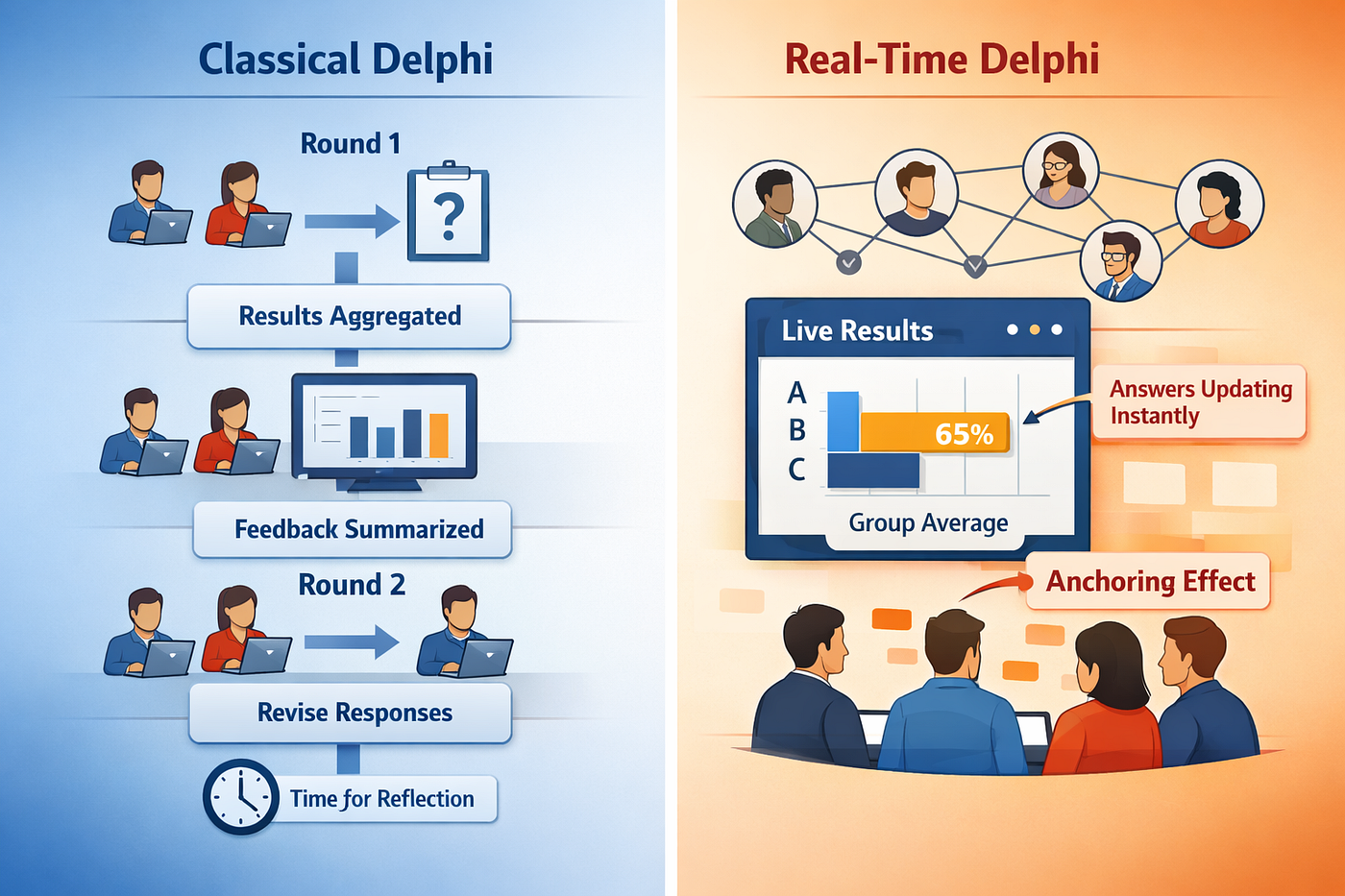
Understanding the trade-offs between speed and independence in expert consultation.
Classical vs. Real-Time Delphi
- In a classical Delphi study, the process unfolds in distinct rounds. Experts submit answers independently, the facilitator aggregates the results, and a new round begins with that feedback visible. This structured iteration gives participants time to reflect before revising their positions.
- Real-Time Delphi (RTD) collapses this into a continuous process. As soon as an expert submits an answer, it becomes part of the live aggregate visible to other participants. There are no rounds to wait for. Experts can log in at any time, see where the group stands, and adjust their responses.
Advantages of Real-Time Delphi
Speed. Classical Delphi studies can take weeks or months. RTD compresses this into days, which matters when organizations need rapid expert input during a crisis or a tight project timeline.
Reduced drop-out. Multi-round studies occasionally suffer from panel attrition. RTD asks for a single, flexible engagement rather than repeated participation across weeks.
Richer interaction. When experts see each other’s reasoning in real time, arguments and counter-arguments develop faster, producing richer qualitative data than the delayed feedback loops of classical Delphi.
The Independence Question
The Delphi method derives its power from independent initial judgments. When experts form opinions without knowing what others think, the aggregate captures genuine diversity of thought. RTD changes this dynamic in important ways.
Anchoring. When a respondent opens a question and sees that most peers have chosen option B, that visible majority acts as a cognitive anchor. Even experts who would have independently arrived at a different position may shift toward the group.
Early responder effect. In classical Delphi, response order does not matter. In RTD, early responders set the initial signal that all subsequent participants react to, giving them disproportionate influence on the final result.
Conformity vs. convergence. Classical Delphi achieves consensus through deliberation — experts consciously decide whether to revise after seeing aggregated feedback. RTD can produce what looks like consensus but may partly reflect the natural tendency to align with a visible majority.
How Mesydel Handles This
Mesydel supports both classical and Real-Time Delphi, with controls designed to let researchers make informed choices:
- Opt-in per round. RTD is not the default. Researchers enable it deliberately on specific rounds, preserving classical independence where needed.
- Anonymity controls. Researchers choose between onymous mode (real names) and anonymous mode (anonymized identifiers), preventing respondents from weighting opinions based on who said them.
- Profile question exclusion. Demographic questions are automatically excluded from real-time display.
- Staff answer filtering. Answers entered by staff on behalf of respondents are excluded from the live aggregate.
When to Use Which
Classical Delphi is better suited when independent expert judgment is paramount, when studying controversial topics where anchoring could skew results, or when measuring genuine opinion change across iterations.
Real-Time Delphi works well when speed is essential, when the goal is rapid consensus-building, when the panel is large and managing multiple rounds would be impractical, or when dynamic interaction between experts is desirable.
The two approaches are complementary tools, not competing ones. The right choice depends on the study’s goals and the nature of the questions being asked.
Mesydel is a Delphi survey platform that supports both classical multi-round studies and Real-Time Delphi. Learn more atmesydel.com.